Sushi Sho — Quiet Greatness
Keiji Nakazawa — not to be confused with the unrelated Daisuke Nakazawa of Sushi Nakazawa — began his culinary training in 1978 at the age of 15. Before opening his first restaurant in Tokyo in 1989, he worked in around twenty sushi restaurants. Early on, he focused on techniques from the Edo period (19th century), where methods such as aging and marinating fish are central — both to deepen flavor and to preserve it. Edo-style sushi — Edomae sushi — has since become the standard at many of the world’s top counters, including Sushi Sho in New York.
Nakazawa is now regarded as one of the most influential sushi masters of his generation. In addition to several restaurants in Japan, he operates one at The Ritz-Carlton in Hawaii and, since 2024, one in New York, where he now resides. The restaurant was immediately awarded two stars in the Michelin Guide — and, since last November, it holds three.
The outward appearance remains understated. On 41st Street, across from the New York Public Library by Bryant Park, only a small wooden sign points the way — aside from a rather imposing door. Walk-ins are not part of the equation. The ten seats are sold in advance via Tock for just under $550 (approx. €480) and disappear quickly. A last-minute opening from the waitlist ultimately dictated the timing of my trip to New York.
After ringing the bell, stepping inside feels like crossing into another world. A world that looks and smells like Japan. Fine woods, carefully chosen objects, soft lighting, uniforms in elegant fabrics. Photography is not permitted — though I find myself wondering if I might attempt a discreet shot at some point.
The first room is not yet the dining space but a kind of waiting area at the counter — a bar. A warm, moist towel is offered, along with buckwheat tea and the beverage list. I begin with a bottle of 2023 Chassagne-Montrachet “Les Mazures” from Domaine Paul Pillot (approx. $330). The room slowly fills; everyone here values punctuality.
The dining room itself is striking. Bright lighting frames the large counter — shaped like a half-octagon — seating ten guests, alongside a minimalist interior filled with carefully considered details. Several chefs work behind Nakazawa, who greets guests in a mix of Japanese and halting English. Attentive staff move quietly behind the counter, though the generous spacing avoids the cramped feeling common at smaller sushi bars.
The meal begins with a small bowl. In a base of dashi, I find cooked Kumamoto oyster from Washington, steamed Japanese sea urchin (Daisen Murasaki Uni), and black maitake mushroom. The warm dish, eaten with a spoon, is gently maritime and unmistakably Japanese. (9/10)
A small bowl of diced apples in varying colors with marinated ginger is provided to refresh the palate — bright, lightly acidic, and invigorating.
The first nigiri features red sea bream (katsugodai). The fish (neta) has been scored lengthwise and dusted with a yolk-vinegar powder. The rice (shari) is loose and distinct, served at body temperature, lightly maritime in aroma, with a creamy yet structured texture. That elusive sense of perfection — the one that makes travel worthwhile — is already present. Still, the flavors, while refined, feel slightly restrained. (8/10)
A maki roll with splendid alfonsino (kinmedai) follows — excellent fish, but surprisingly little tension beyond the ingredient itself. (7/10)
After this mildly tentative opening, the level rises sharply. A sardine maki with shiso, cucumber, and vegetables is outstanding — the minty lift of the perilla leaf, the crunch of cucumber, the creamy acidity of the fish. (9/10)
Next comes nigiri of masu salmon cured in cherry blossoms, lending a subtle floral note. There is also a quiet play on words — “sakura masu” translates to “cherry trout,” though not because of its flavor. The fish, both texturally and aromatically engaging, meets the warm, airy rice — a clear signature of Nakazawa’s style. Undeniably world-class. (8.9/10)
I order sake by the glass — still, for me, the most fitting companion to sushi.
The high level continues with a white-on-white roll of seasonal squid roe and cooked squid — an experience defined by the interplay of textures, from creamy to granular. A precise touch of wasabi adds lift. (9/10)
Nakazawa continuously varies the format. Two small bowls arrive — one with clear, hot dashi, the other with puréed daikon — alongside a plate with two cuts of longtooth grouper (kue): back and belly. The course is designed as shabu-shabu: a piece of fish briefly swirled in the broth, then combined with the cool radish. The fish is rich, tender, and deeply umami. The broth, now enriched by the fish, is then drunk. The subtlety of such a seemingly simple dish is remarkable. (9/10)
A single slice of fish, served alone, can reach the same level: smoked bonito, about five millimeters thick, with a firm yet delicate texture, notes of smoke and fire, and the clarity of its pure flavor. Remarkable. (9/10)
Bonito returns in a supporting role — lightly dried, almost like ham, wrapped around cucumber. The crisp freshness of the vegetable and the smoky, maritime character of the fish taste like summer itself. (9/10)
Another nigiri follows: filefish (kawahagi) topped with its liver. With chives, it evokes sour cream on the palate. Acidity, umami, and the airy rice combine beautifully. (9/10)
A small dish of dried roe (karasumi) — from herring and mullet — provides contrast. Unlike the dense, waxy bottarga of Italy, karasumi is granular and crisp, each egg perceptible, audibly so. Intense, salty, maritime — and elevated by a fine citrus zest that adds elegance. (9/10)
Hokkaido scallop follows. Sweet, fleshy, buttery — without the slightest hint of fishiness. Nakazawa explains that this quality is available only for a brief two-month window each year. The warm, loose rice supports and structures the sweetness. Another outstanding piece. (9/10)
Sweetly pickled daikon and radishes (bettarazuke) are served simply. The marinade preserves their bite while introducing a fine sweetness and clear freshness. Exceptional. (8.5/10)
Two pieces of fermented fish follow — flounder and herring with Japanese peach. The textures are compelling, the flavor reminiscent of pickled herring, with a subtle sweetness — and the sense of encountering something entirely new. Deeply impressive. (9/10)
Two pieces of monkfish liver (ankimo) arrive next. One is topped with three-year-aged watermelon, the other with fresh wasabi — of exceptional quality, bright green and aromatic. The maritime foie gras — creamy, rich, but less dense — achieves perfect balance: sweet-acidic freshness on one side, precise heat on the other. The richness is both restrained and enlivened, without losing intensity. Absolutely magnificent. (10/10)
By now, a pattern has emerged: Nakazawa’s alternation between nigiri and other preparations creates tension, while the overall language remains resolutely Japanese.
A half marinated physalis serves as a brief palate cleanser.
Then comes nigiri with hairy crab (kegani) and vinegar-marinated egg yolk powder. The crab is nutty, sweet, juicy; the acidity is appetizing and fluid. Masterful. (9/10)
Another surprise follows: fermented rice (“rice cheese”) wrapped in smoked, marinated daikon. Creaminess, smoke, and fresh crunch align in a strikingly balanced composition. Each bite delights. (9/10)
The final nigiri of the menu is soy-marinated, aged toro — a small masterpiece. Melt, umami, acidity, temperature, grain, creaminess — all at the highest level. (9/10)
An ichiban dashi — made from dried bonito and kombu — closes the sequence with extraordinary clarity and depth. Nothing dominates, nothing is excessive — and from this restraint comes remarkable intensity. A simple masterpiece. (10/10)
At this point, the official menu — somewhat confusingly called the “Shorter Omakase” — comes to an end. What follows is self-directed: okonomi, the à la carte portion, where additional nigiri are encouraged. Prices range from $20 to $60 per piece.
The investment proves worthwhile. Masu salmon roe (tsukimi ikura) surprises with floral notes (9/10); firefly squid (hotaru ika) is more intense — salty and maritime (9/10). Sea urchin from Aomori (Daisen Murasaki Uni) is deep, cool, and creamy (9/10), while a sardine roll (iwashi) with chives is heavenly (10/10).
Sunazuri — a rare cut from the lower belly of the tuna — follows, offering the umami depth of toro with less overt fat. One could applaud — I limit myself to a quiet “Oishii!” (delicious), which earns a smile from the chef. (10/10)
A nigiri of yeast-marinated tomato maintains the umami intensity without excess (9/10), and a final composition of two styles of tamago — from Kyoto and Tokyo — with watermelon and rice provides a fitting close. (9/10)
In a separate room, a dessert of transparent arrowroot noodles in a cool syrup of Okinawan brown sugar is served — quietly remarkable. (9/10)
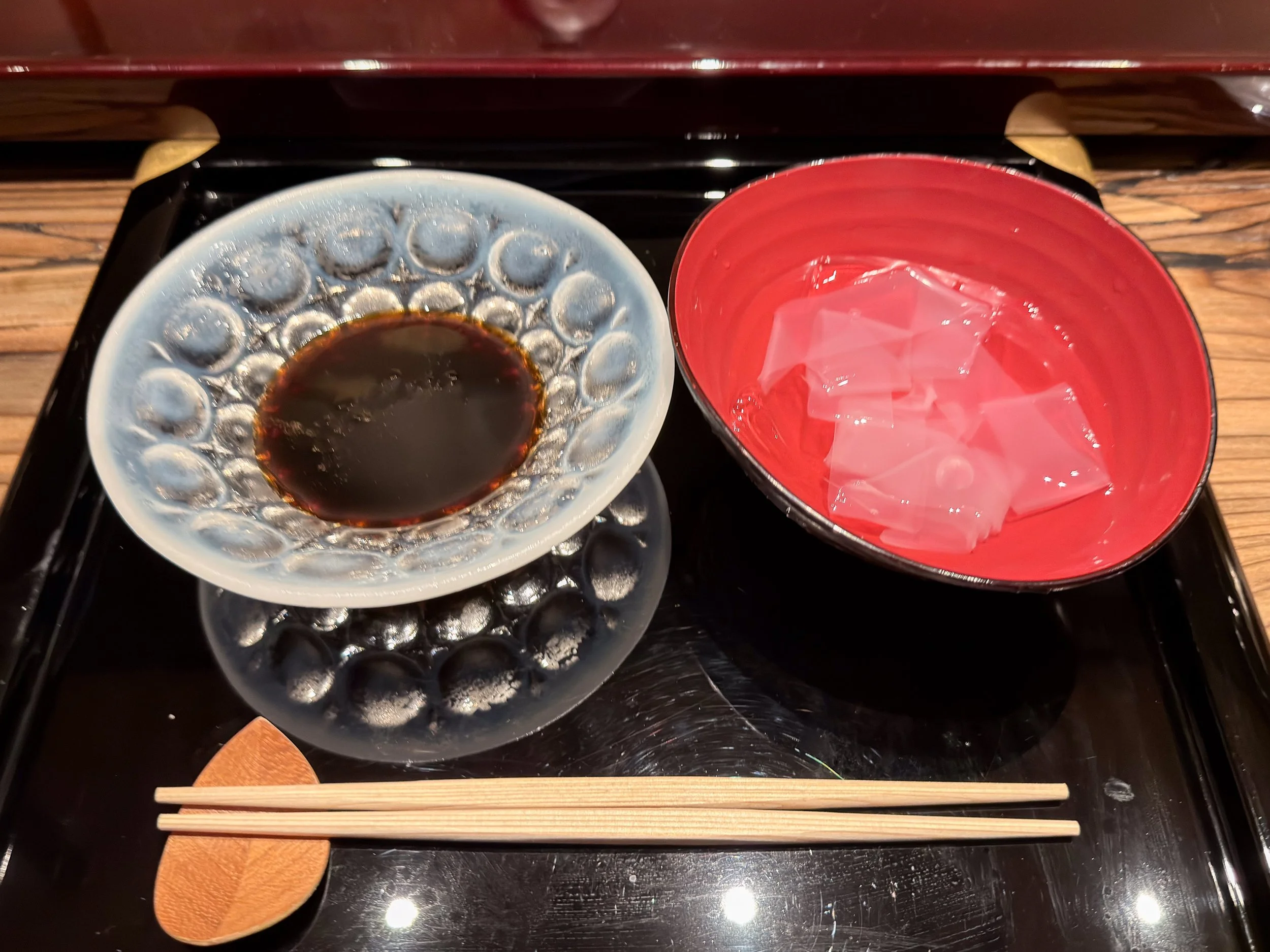
A salted milk ice cream, combined with the remaining syrup, refreshes once more. (8/10)
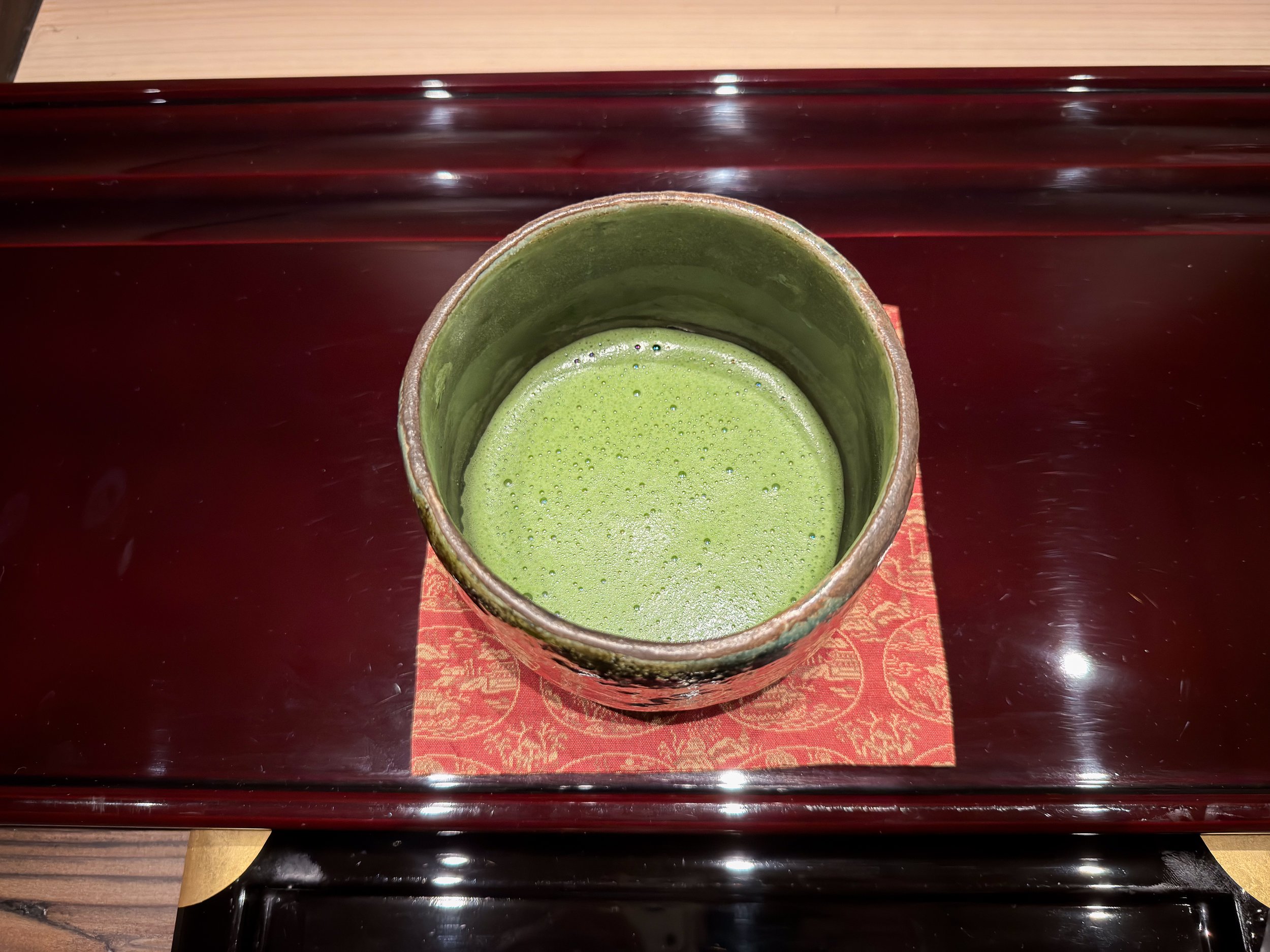
After a final matcha — prepared personally by Ms. Nakazawa — the evening ends with a cup of hot water, drawn from the vessel used for the tea. It is difficult to imagine a more understated expression of greatness.